A
space heater is a device for heating an enclosed area.
[1] Space heating is generally employed to warm a small space, and is usually held in contrast with central heating, which warms many connected spaces at once. Permanently installed space heaters may use electricity or burn natural gas, propane, fuel oil or wood pellets and may operate on heat pump principles and may provide air conditioning. For portable use electric heaters are most appropriate, because gas heating can be very dangerous without a permanent flue.
Types of heaters
Space heaters can be divided into those that transfer their heat primarily by convection, or by radiation.
Convective heaters
In convection heaters, heating elements
either warm the air directly or heat oil or another filler, which in
turn transfers heat to the air. The air then warms the objects and
people in the space. Convective heaters are suitable for providing
constant, diffuse heat in well-insulated rooms. Oil heaters
warm up slowly but do not reach dangerous surface temperatures;
wire-element heaters, which may be fan assisted, produce warm air more
quickly but may pose a fire hazard.
[2][3] One particular type of convective heater is the fan heater.
Radiative heaters
Infrared radiant heater, made by Honeywell
See also: Infrared heater
The main advantage of radiative heaters is that the infrared
radiation they produce is absorbed directly by clothing and skin,
without first heating the air in the space. This makes them suitable for
warming people in poorly insulated rooms, or even outdoors.
Some of the earliest electric heater were radiative, consisting of Nichrome heating wires held by ceramic or mica insulation at the focal point of a (usually) polished metal reflector.
The cost was very low since nothing else, not even a switch, was
needed. Later models included a wire guard preventing accidental contact
with the heating wires or the hot ceramic.
However the metal reflectors needed to be fairly heavy gauge, and if
the size was reduced then the metal housing would get too hot to be
safe. In the mid-20th century the cheapest heaters were radiative, but
with the heating wires stretched relatively closely across a larger thin
metal reflector separated from a thin metal housing. A small fan blew
just enough air between the housing and the reflector to cool them; the
main output to the room was the radiative heat and not the heated air.
Having the heating wires stretched across a larger area meant that fewer
expensive ceramic insulators were needed, and the small fan was cheaper
than a larger or heavier housing.
Quartz heaters are radiative heaters which were more
efficient, in the amount and directionality of heating, by using coiled
heating wire inside unsealed quartz
tubing. The wires could thus operate at a higher temperature than
practical with ceramic-supported wires or be thinner. If the heating
elements were at a higher temperature, then proportionally more energy
was radiated compared to open-wire heaters.
Halogen heaters comprise tungsten
filaments in sealed quartz envelopes, mounted in front of a metal
reflector in a plastic case. They operate at a higher temperature than Nichrome
wire heaters but not as high as incandescent light bulbs, radiating
primarily in the infrared spectrum. They convert up to 86% of their
input power to radiant energy, losing the remainder to conductive and
convective heat.
[4] The halogen cycle reduces the darkening of the quartz envelope and lengthens the life of the filament.
Power sources
Many of these space heaters, including those of oil-filled radiators
and natural stone heaters, are plugged into an electric power source,
most commonly a mains outlet. The power ratings of appliances are
measured in kW, which allows an easy estimation of operation cost per hour, as energy is billed in kWh.
Safety issues
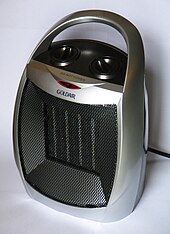
A Goldair ceramic heater, a Breville Group brand
The two primary health risks from heaters are the risk of fire and the risk of carbon monoxide poisoning.
The latter risk applies to gas and kerosene heaters but not electric
heaters. The risk of fire from heaters may be mitigated by low surface
temperatures (as found on oil-filled convective heaters), or by switches
that cut power in the event of the device inadvertently being tipped
over (often found in the bases of halogen heaters), or by thermal
cut-out switches. Natural Stone Heaters do not pose a fire or carbon
monoxide poisoning risk, and can be a safer alternative. However, the
surface temperatures of the stone heaters can be considerable, though
they may not cause an instant burn as the heat transfer is slow. For
that reason they are usually mounted high on walls or ceilings, away
from the reach of infants.
Within the United States, Underwriters Laboratories maintains standards UL 1278
[5] for portable electric space heaters, and UL 1042
[6] for portable and fixed baseboard electric heaters. The General Services Administration used to maintain Specification W-H-193
[7]
for electric space heaters, but this was cancelled in 1995 in favor of
the UL standards. Additional information on portable heater safety may
be found at the Department of Energy Energy Efficiency website.
[8] Also, the "EPA does not currently label space heaters as an ENERGY STAR qualified product...".
[9]